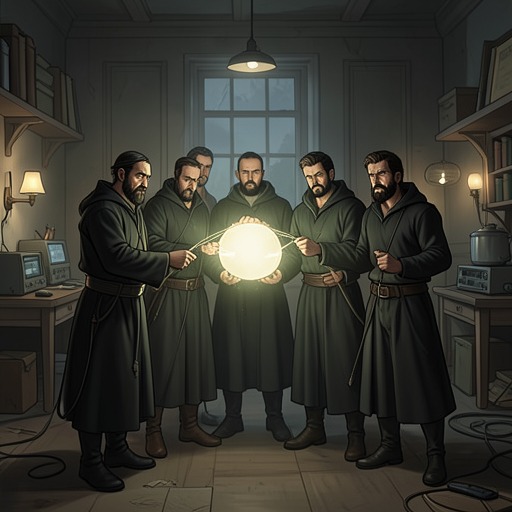
Discovery of the star that dooms humanity
Last and First MenThe discovery of the star that dooms humanity transforms a distant astronomical spectacle into a measured deadline for the Last Men. What first seemed an intriguing change in a neighboring star proves to be an unprecedented stellar disorder; its effects are spreading through space, and the Sun cannot remain untouched. The forecast gives humanity a few thousand years before the Sun begins to disintegrate, but far less time to find refuge: life will become impossible across a vast region within thirty thousand years, and Earth cannot be moved out of danger in time.
Causes and Detection
The change was observed in a nearby star without any discoverable cause. It shifted from white to violet and grew brighter. Although its disk remained only a point in the sky, its purple light became brilliant enough to illuminate the night landscapes of Earth.
Astronomers ruled out an ordinary nova or a star undergoing one of its familiar bursts of brilliance. They instead identified a normal star suffering from a unique disorder: its vital process had accelerated fantastically, squandering energy that should have remained locked within it for aeons. At that rate, the star would be reduced to an inert cinder or annihilated within a few thousand years.
Competing Explanations
The cause remained uncertain. The disorder might have resulted from imprudent interference by intelligent beings in the star’s neighborhood. But the astronomers also recognized a natural possibility: matter at very high temperatures exists in an unstable equilibrium, and a conjunction of circumstances might have been enough to trigger the change.
That uncertainty did not make the danger remote or hypothetical. Whether the initiating cause was artificial or natural, the observed transformation supplied evidence of a process that could spread beyond the afflicted star. The account leaves the origin unresolved while making the consequences increasingly clear.
From Spectacle to Forecast
At first, the altered star was regarded simply as an intriguing spectacle. Further study changed the meaning of the light. Earth, and therefore the Sun, was being continuously and increasingly bombarded by ethereal vibrations, most of them at frequencies so high that their potential effects were unknown.
After some centuries, astronomical bodies near the disordered star began to show the same condition. Their increasing brilliance heightened the spectacle in the night sky, but their infection also confirmed that the phenomenon was not confined to its first observed source. The Sun’s distance offered the Last Men a possible reprieve, not protection: analysis indicated that the bombardment’s cumulative effects could take thousands of years to reach the point of disintegration, but would eventually infect the Sun as well.
Consequences and Significance
The forecast separates two deadlines that might otherwise be confused. The Sun’s own disintegration would follow after a delay of thousands of years; life, however, would become impossible anywhere within a vast radius of it probably within thirty thousand years. The threat therefore did not depend on humanity waiting until the Sun’s final destruction. Its habitable region would fail first.
Nor could the Last Men save Earth by propelling it away. The radius of danger was so vast that the planet could not be moved fast enough to escape before the approaching storm overtook it. The discovery thus turns humanity’s long-standing awareness of its precarious existence into a specific, inescapable prognosis: the danger comes not from a collision or an ordinary stellar outburst, but from a disorder whose effects propagate through space and reach the Sun. Its decisive consequence is not merely that humanity faces an end, but that astronomical observation establishes the end as a physical process already advancing toward its home.